
Outstanding Warrants in Grady County
"Active" only means what its source says. A Grady County docket can show a bench warrant issued months ago, with the recall or release entered later in the same case. A sheriff listing can sit stale. A city court may run its own process entirely outside OSCN and the Most Wanted page. Treat any one screen as a clue. It is not the answer. The Grady County Sheriff's Most Wanted interface posts no complete count and no statement of completeness, and it carries an update notice. That makes it a starting point. For an active-warrant question, the issuing court comes first, then the sheriff or police contact that serves the paperwork. District Court cases: search OSCN and call the Court Clerk at (405) 224-7446. For a city ticket, use the court named on it.
Grady County Warrant Update Notice
The Grady County Sheriff's Most Wanted page speaks plainly. The list is being updated, it says, so check back later. It also warns that entries may not be current. Nothing there is represented as current for a legal purpose. Dollar amounts are approximate, since fees and payments change. Read that plainly. This is a publication with routine updates, not a real-time active-warrant system. The page says no action should rest on the record alone. Call the sheriff or local law enforcement instead. Never attempt an apprehension yourself. The update notice and blank program controls are right on the official Most Wanted page, and for your own status the issuing court confirms the current record.
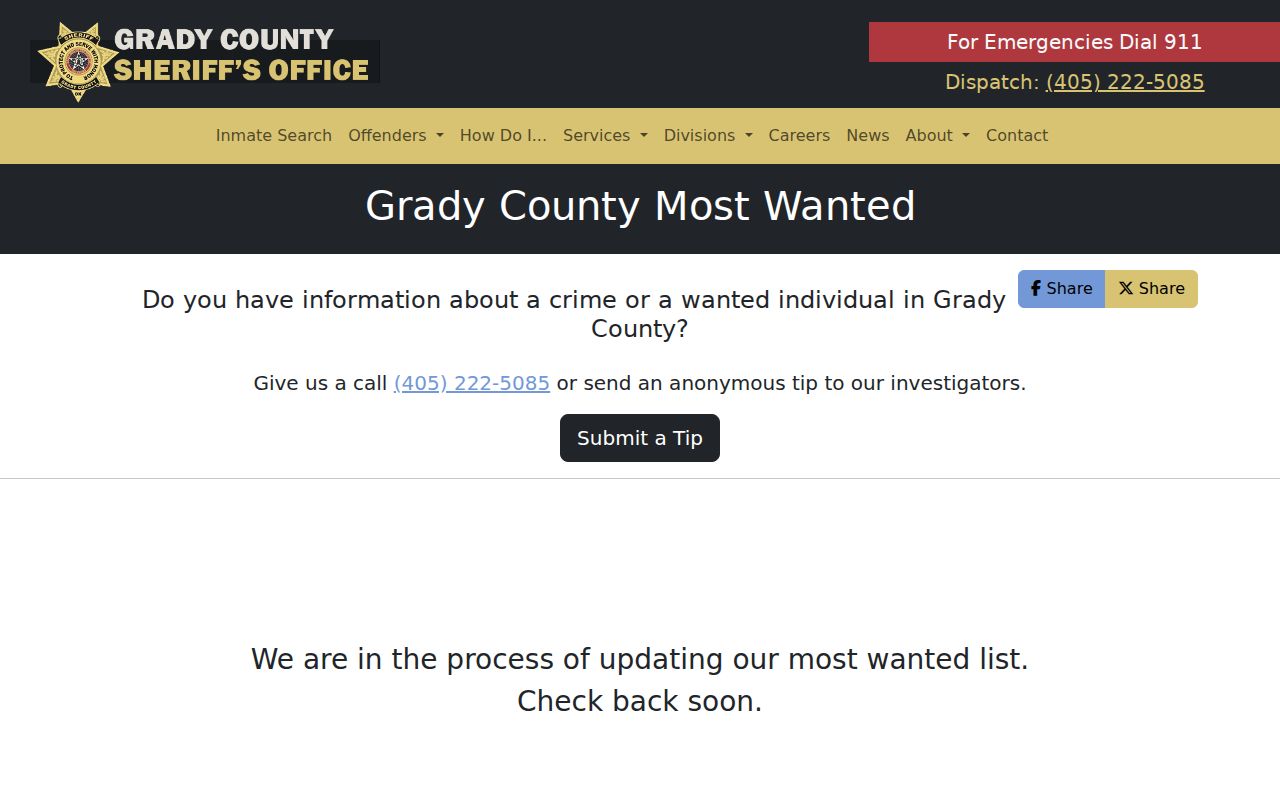
A program page can change between visits, so the source should be checked directly.
The Grady County Active Warrant List
No single Grady County list combines District Court, Chickasha, Tuttle, Ninnekah, Minco and Rush Springs records. The public record is split by court and agency. OSCN covers participating District Court dockets. Chickasha and Tuttle maintain separate municipal portals, while Ninnekah relies on dated PDF links and Minco and Rush Springs post no current portal at all. That is the whole map. The sheriff's page is a curated subset. It is not a complete active-warrant search for Grady County. A missing name there clears nothing. A name on a dated list proves nothing current. When an online source goes quiet, write down the case or citation number, the court and the date. Then ask the clerk a direct question: which later entry shows the warrant as active, recalled, served or cleared?
Why Grady County Warrant Records Stay Separate
A Grady District Court case and a Chickasha municipal citation never share a file. Different courts, different clerks, different routes. OSCN's traffic-citation search covers District Court only. It says municipal citations are not searched. A city portal may show a payment view without the full court order, and a sheriff list shows only what law enforcement chose to publish in Grady County.
| Record route | What it can cover | What it cannot prove |
|---|---|---|
| OSCN and Court Clerk | District Court cases and docket events. | Every city citation or current service status. |
| Sheriff Most Wanted | Curated public-safety program entries. | A complete county list or live legal status. |
| Municipal court | City ordinance and municipal traffic matters. | District Court felony or misdemeanor records. |
| GCCJA | Facility and custody routing. | Issuance, recall or a countywide register. |
That is a system design fact, not a search failure.
Active Warrants: What They Show
A public record shows only part of the file. Read the court, the process type and the date first, then check whether later Grady County entries change the result.
| Case identifier | OSCN case number or city citation identifier. No universal Grady warrant-number format was located. |
|---|---|
| Event or process | Bench warrant, issue warrant of arrest, FTA, cost cite and release or another local term. |
| Issuing court | District Court of Grady County or a named municipal court. |
| Bond or amount | May appear as an appearance-bond or fee entry. A posted fee is not automatically a bond. |
| Currentness | Service, recall, quash, payment, release or a new setting may follow the first event. |
OSCN warns its online case information is not certified. The Grady County Court Clerk can tell you what current or certified record is actually available.
Grady County Warrant Lists Are Historical
Ninnekah's police page links two PDFs: "Warrant List 2005-2021" and "Warrant List 2021-2022." It also posts a 2026 court-date block. Those labels prove dated material was published once. They prove nothing about a live roster. See a name you recognize? Call the current Ninnekah city or police contact at (405) 222-0882 and ask which municipal clerk handles status, payment and recall. A court calendar is not a warrant-status field. The Grady County sheriff's page and OSCN cannot answer for Ninnekah Municipal Court. If the case is actually in District Court, the Court Clerk route applies instead. Ask which court issued the record before you conclude anything about a Grady County warrant.
Grady County Warrant Roundups
Grady County has no amnesty week, safe-surrender event, roundup hotline, or warrant-fee reduction on any county or city page. The sheriff's Most Wanted page is a curated publication, not a roundup calendar. It names selected people. Chickasha's Food for Fines program cut municipal fines in its 2025 report, but that report never calls it warrant amnesty. Don't borrow an event from another Oklahoma city, either. If Grady County ever announces a real one, its official page will list the dates, the court, eligible cases, the fees, and the exact action required. Don't wait for a roundup. Call the court named on the notice. Ask what current action your case needs. That one call tells you more than any event calendar could.
Finding Your Own Name on the List
Never approach another person over a listing. If the name is yours, contact the issuing court in Grady County and ask for current status, case number, event date, and next step. A relative can't check on someone else's behalf. Have the relative or authorized counsel make the direct request.
Confirm first: the sheriff page says not to act solely on a listed record and not to attempt an apprehension. Presence or absence on a curated page does not replace the issuing court.
Ask what the matter actually is: a bench warrant, arrest warrant, municipal process, cost cite and release, bond forfeiture, or another docket event. Then ask what resolves it. A lawyer, motion, payment, appearance, bond, or new setting may be required. Grady County posts no same-day walk-in recall process. Once you act, get proof. Ask what written order, receipt, or docket entry will show the update.
Calling Grady County About Warrants
The sheriff's administration and records line is (405) 222-5085. The non-emergency line, (405) 224-0984, is answered 24/7. The jail or GCCJA line is (405) 222-1000. These Grady County lines route your call; they don't let the sheriff recall every court's warrant.
Grady County Court Clerk
District Court warrant events and case-file questions.
(405) 224-7446
Grady County Sheriff's Office
Sheriff-held records and law-enforcement routing.
(405) 222-5085
GCCJA
Custody and facility logistics after court direction.
(405) 222-1000
State your case or citation number. Ask one narrow question, naming the court too, so a Grady County city matter isn't sent to the wrong office.
Grady County Warrant Records Requests
When a phone call won't surface an existing public record, go to the office that holds it. Grady County's records form asks for a reasonable description, the purpose, and your contact details. The sheriff's form covers sheriff-held disposition and service records. Fees, redactions, and subpoena notice may apply. Ask for a date range and disposition field. Don't ask an office to build a new countywide active-warrant list. Leave out juvenile, sealed, and confidential material. If a Grady County city court holds the record, send the request straight to that city rather than assuming the county can produce it. Your own current status belongs with the issuing court, not a broad records request. A request proves a record exists; it won't guarantee a current-status answer.